Accidental vs. Intentional Burns
Scald burns to the feet and lower extremities in children are described in the literature as often resulting from forced immersions. This report illustrates 2 cases of burns whose distribution and historical factors identify them as accidental.
The location of accidental burns is similar to those found in inflicted injury, but often the patterns were indicative of flowing water burns, not forced immersions. Burns in these locations may be confused with abuse. Medical providers and more importantly investigators need to be aware of information that may enable them to distinguish the two causes.
Effective caregiver education regarding the importance of lowering the temperature of water heaters and discouraging play in household sinks is critical to prevent additional tap water scald burn injuries. Scald burns are the leading cause of pediatric burn admissions and related morbidity, as well as a major cause of pediatric death. These injuries disproportionately affect the 0- to 4-year age group with the vast majority occurring in the home. Scald burns may result from either accidental or inflicted trauma; however, tap water scald burns are more likely than other types of burn injuries to represent child abuse. Up to 14% of pediatric scalds overall and 45% of those resulting from tap water are inflicted by adults.
Burn injuries to the lower extremities, particularly bilateral burns with distinct borders, almost exclusively are reported to result from abusive trauma. Our review of the medical and surgical literature revealed no case reports of accidental scald injuries mimicking abuse. We present a case series of accidental burns to the lower extremities with several features distinguishing them from abusive trauma.

Case 1
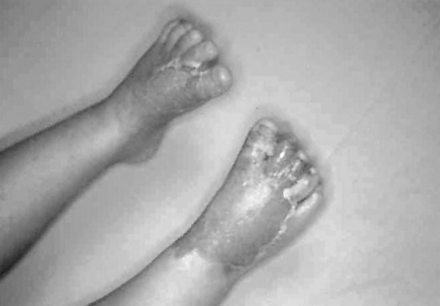
An 18-month-old previously healthy boy with normal growth and development was admitted to the burn unit at an academic medical center with partial- and full-thickness burns to both feet. The injury on his right foot encompassed most of the dorsum beginning at the flexural crease of the ankle and extending to include half of his great toe and the complete second, third, and fourth toes, sparing the fifth toe and the sole. The injury to his left foot involved one third of the dorsum medially and extended to include his great toe and part of his second toe, also sparing the sole. The margins and depth of the burns were irregular (Fig 1). The only other injuries on his legs were three 1- to 2-cm round burns scattered on the medial right ankle. Complete physical evaluation and skeletal survey revealed no other injuries.
FIGURE 1: Bilateral scald burns on lower extremities of Case 1.
Note asymmetry and irregular margins.
History obtained by interviewing the parents alone revealed that the mother and father were at home with the child, both of whom assumed that the child was with the other parent. The mother heard her son screaming and ran to the bathroom to find him climbing out of the sink with his left foot on the counter beside the sink and his right foot under running water. She commented that she had seen her son sitting on the sink on several occasions before this incident. He often brushed his teeth while sitting in that location, but she had never observed him turning on the water by himself.
Scene investigation of the home by law enforcement and child protective services verified that the bathroom had a toilet to the left of a small counter-top sink. The apartment building in which the family lived provided scald guards for the water heaters, but the guard had been removed from their unit. The maximum water temperature obtained from their faucets was determined to be >150°F. The multidisciplinary team evaluating the history, burn pattern, and scene investigation concluded that the burns were consistent with those of a child’s using the toilet to climb into the sink and turning on the water by himself. The irregular margins and depth of injury with lack of stocking pattern were indicative of flowing water injury rather than an inflicted immersion.
Case 2
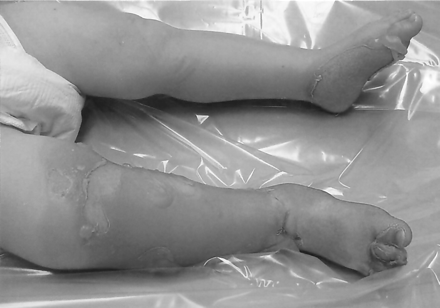
An 18-month-old previously healthy boy with normal growth and development was admitted to the pediatric trauma service at an academic medical center with 10% total body surface area partial- and full-thickness burns to his lower extremities. The injuries to the right leg began at the knee and extended distally to involve the entire right foot, including the sole and toes. The area under his right knee was spared, but superficial burns in a running water pattern were noted over his posterior thigh, ending abruptly in a line at his buttocks. The injuries to the left foot encompassed the medial aspect of the foot extending around the arch of his foot onto the dorsum and extending to involve almost the entire sole. The toes and intertriginous areas were spared. There were no splash marks, and the margins and depth of the burns were irregular (Fig 2). No other injuries were identified after thorough medical evaluation.
Figure 2: Asymmetric, bilateral scald burns of lower extremities of Case 2.
Note irregular margins of burns.
Before the incident, the child’s mother reported having seen her son standing on the stool in front of the bathroom sink playing in the water. She went into another room to fold clothes then heard him screaming and returned to find him sitting in the sink with water running. His left leg was folded out on the counter and the right leg was in the sink. His mother commented that her son often climbed onto the bathroom sink to brush his teeth and to play.
Photographs were obtained of the bathroom during a scene investigation that demonstrated a small stepping stool in front of the sink. The maximum water temperature was determined to be 140°F. A multidisciplinary team including physicians, social workers, and investigators recreated the scene as described by the patient’s mother and determined that the burn pattern was consistent with the reported mechanism of injury.
Discussion
The evaluation of burns requires careful attention to historical information, physical examination, and scene investigation. Both the history provided by the caregivers and the physical capabilities and developmental age of the child play important roles in assessment of burn cause. Injury inconsistent with the history provided by the caregiver is 1 of the most predictive factors for inflicted injury.
Patterns of burns are useful in the evaluation of injury. Familiarity with the patterns of burns permits appropriate recognition of both accidental and inflicted injuries. Burns to the hands, legs, feet, and buttocks have been described throughout the literature as predominant sites of abuse. Simultaneous scald burns to the buttocks, perineum, and feet are diagnostic of deliberate injury. Inflicted immersion injuries are characterized by uniform burn depth with distinct wound borders clearly delineating burned from unburned skin. In contrast, accidental injuries often demonstrate indistinct borders or multiple areas of burn as the patient struggles to escape from the hot liquid. Typically, accidental scalding from hot tap water leaves irregular marks and splashes.
The physical similarities in the 3 cases, which may help to distinguish accidental from inflicted burns, are asymmetry of extremity involvement, irregular burn margins, irregular burn depth, and position of the burns. The burn pattern demonstrated in all 3 children was asymmetric, with 1 extremity substantially more affected than the other. Although both feet or lower extremities were affected as commonly is seen in forced immersion injuries, these burns were not circumferential and did not mimic a “stocking” distribution. This may be explained by the involvement of a bathroom sink in the scalds. Bathroom sinks are shallow, and a child sitting on the side of the sink will typically have 1 leg directly under the faucet and the other extremity away from the direct flow of water. The other extremity may be burned either from water running off the more affected leg or from scalding water pooling in the sink, burning the most inferior portion of whichever extremity is in the sink. Sitting directly in front of a sink faucet may be difficult, eliminating the more symmetric pattern that would be seen with both feet placed equally under the water stream.
Irregular burn margins are indicative of movement within the water. These cases did show some irregularity of border, with occasional scalloped edges rather than the crisp “stocking-like” margins seen in children who are forcefully restrained. In addition, the burn margins were predominately more superficial, and the depth of burns overall varied within confluent regions. Inflicted immersions tend to be of uniform depth as a result of the inability of the child to move in the water.
These sink-related burns were predominantly anterior, resulting from the knee and shin coming directly in contact with the water, whereas calf, thigh, and intertriginous areas were relatively spared. The relative confinement of the sink area, in addition to the likelihood that the children faced the water to play with it, may have contributed to the anterior position of the burns. In an accidental tub burn, children may be burned by water coming from both above and below, and children are free to move around in the stream. Their freedom of movement as they try to escape may result in more variability of both the borders and placement of the burns. It is interesting to note that none of our patients fell off the sink after being burned, suggesting fear of falling may have influenced their escape from the hot water.
Consideration should be given to the absence of splash marks in these cases. In the literature, the presence of splash marks often supports accidental injury, presumably from children in motion attempting to escape from hot water. In our series, minor splash marks were observed in only 1 case. Several explanations could account for this. Although seated in the sink, the children themselves may act as a conduit for water flow, producing more flowing burn patterns than splashes. Splashes from impact with deep standing water would not be expected in a shallow sink as opposed to the deeper tub. It is possible that aerators in modern sinks may reduce splash directly from the faucet. Although not applicable to these cases, at temperatures below 130°F, splash marks do not occur because burning is not instantaneous at that temperature. In lower water temperatures, the absence of splash marks does not support accidental or inflicted injury.
Conclusion
There were striking historical similarities in these cases. All involved young toddlers known to play in or around bathroom sinks. The toddlers all had easy climbing access and were left unsupervised for short periods of time. In all of the cases, the parents had previously allowed or encouraged activities near the sink. In addition, the water heaters in all of the homes were set at or above 140°F.
It is clear that children can sustain significant accidental burn injury in sinks, primarily as a result of high water temperatures. The length of time required to produce injuries decreases exponentially as the temperature of water increases. Data exist regarding time to cutaneous burning as a product of the temperature of water in adults. It has been hypothesized that at temperatures >130°F, children can burn in one fourth to one half the time of adults. Second- and third-degree burns are estimated to occur in 1 second at 140°F and in only half of a second at 149°F.


Get social with us!


